Deciding on a Watercolor Summer Hibiscus Flower Wreath for Your Creative Projects
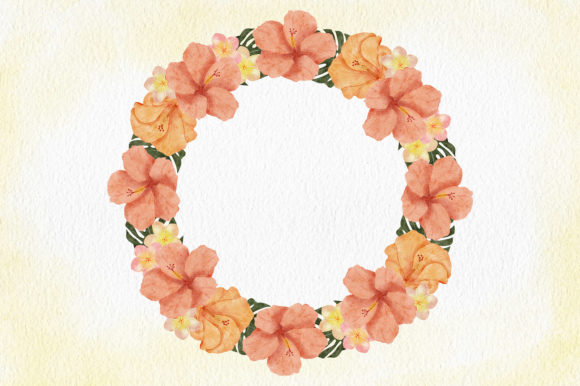
The world of digital floral illustrations is vast, and among the many offerings, a Watercolor Summer Hibiscus Flower Wreath stands out as a specific and evocative resource. This type of clip art package typically centers on a circular wreath composition, often featuring lush, hand-painted hibiscus blooms and complementary elements like leaves, buds, or accent florals rendered in a soft, textured watercolor style. The distinctiveness lies in the combination of a complete, ready-to-use wreath motif alongside individual, isolated flower elements. This dual offering provides both a cohesive design and modular components, granting users flexibility that single-image packs often lack.
Understanding the Core Components and Formats
When evaluating a package like this, it’s crucial to look beyond the aesthetic appeal and understand its practical makeup. A typical Watercolor Summer Hibiscus Flower Wreath collection includes the central wreath illustration and a set of hand-painted hibiscus flower elements. These elements are the individual flowers, petals, leaves, and perhaps other botanical details that allow for custom arrangements. The technical specifications, such as high-resolution 2000px by 2000px files in both .JPG and .PNG formats, are significant decision factors. The .PNG format with transparency support is particularly valuable for designers, enabling seamless overlays on various backgrounds without tedious manual cropping. The high resolution ensures quality across both digital displays and print projects, a key point of comparison against lower-resolution, web-only graphics.
Key Strengths and Primary Use Cases
The primary strength of a Watercolor Summer Hibiscus Flower Wreath package is its balance between a finished art piece and a customizable toolkit. The wreath itself serves as an instant solution for invitations, logo frames, website headers, or social media graphics where a polished, tropical theme is desired. Meanwhile, the isolated elements empower users to build unique designs for merchandise, fabric patterns, or mixed-media art. The watercolor style itself offers a soft, organic, and artistic feel compared to vector illustrations, which can appear more crisp and digital. This makes it a compelling fit for projects targeting a handcrafted, warm, or summery audience.
For example, a small business creating a limited-run summer marketing campaign might use the wreath directly on promotional materials for consistency. An independent stationery designer, however, might heavily utilize the separate flower elements to create a unique repeating pattern for a line of notebooks, leveraging the transparency of the PNGs to layer over different colored backgrounds. In these scenarios, the package’s value is multiplied because it addresses two distinct design approaches within one purchase.
Evaluating Trade-offs and Potential Limitations
While versatile, a focused package like this does have inherent trade-offs. Its specificity is both a benefit and a constraint. The theme is firmly anchored to summer, hibiscus, and a watercolor texture. If your project requires autumn motifs, geometric styles, or a different floral species, this resource would be a mismatch. Compared to broader “watercolor flower bundles” that might include dozens of varied species, the Watercolor Summer Hibiscus Flower Wreath offers depth within a narrow theme rather than breadth across many themes.
Another consideration is the artistic style. Watercolor illustrations have an inherent, uncontrolled texture that may not align with projects requiring ultra-sharp, minimalist, or flat-design aesthetics. Furthermore, while high resolution is a plus, the fixed 2000px dimensions mean the wreath cannot be scaled infinitely without potential quality loss, unlike a true vector graphic. For very large-scale print work like billboards, a vector-based wreath might be a more suitable alternative, though it would lack the authentic watercolor feel.
Comparison with Other Common Resource Types
When researching floral graphics, you’ll encounter several categories. Understanding how a Watercolor Summer Hibiscus Flower Wreath fits among them aids in decision-making.
- Vector Illustration Packs: These offer infinite scalability and often easier color editing via software like Adobe Illustrator. However, they typically lack the organic, textured artistry of hand-painted watercolor. Your choice hinges on whether technical scalability or artistic authenticity is paramount.
- Photographic Stock Images: Real hibiscus photos provide literal realism. A watercolor illustration, conversely, offers stylized interpretation and is often easier to integrate into designs without competing with other photographic elements. It’s a choice between realism and artistic integration.
- Massive Multi-Style Bundles: Some clip art bundles include thousands of items across various styles. While cost-effective for diverse needs, they can be overwhelming, and the quality within a specific niche (like watercolor hibiscus) may not be as deep or cohesive as a dedicated package.
The Watercolor Summer Hibiscus Flower Wreath occupies a middle ground: it provides focused, high-quality assets for a specific visual need without the clutter of an unrelated bundle.
Decision Factors: When Is This the Right Choice?
Determining if this resource is the best fit depends on aligning its attributes with your project’s concrete requirements. It may be the right choice when:
- Your project’s theme explicitly calls for a summer, tropical, or hibiscus-centric aesthetic.
- You value the look of hand-painted artistry over digitally perfect vectors.
- You need both a ready-made focal point (the wreath) and deconstructed parts for custom design work.
- Your outputs include both digital media and mid-scale print items (like posters, cards, or apparel) where 2000px resolution is sufficient.
- You prefer working with transparent PNG files for efficient compositing.
Situations Where Another Option May Be Needed
Conversely, you might need to explore other options if:
- Your project requires frequent, drastic resizing for very large formats, making vector graphics a more practical long-term resource.
- You need floral diversity for a general “flower” theme rather than a specific hibiscus theme.
- The required art style is corporate, ultra-modern, or geometric, making the organic watercolor texture visually incompatible.
- You only need a single wreath image and have no use for separated elements, in which case a standalone wreath purchase might be more economical.
For instance, a web designer building a year-round botanical blog might need a wider variety of flowers, whereas a designer creating a one-off summer festival identity could find the hibiscus package perfectly sufficient.
Integrating the Assets into Real-World Workflows
Beyond acquisition, practical use is key. The inclusion of both a wreath and elements encourages a layered workflow. A common approach is to use the wreath as a foundational graphic, then augment it with the isolated flowers to create variations or highlight specific areas. The high-resolution files allow for cropping and detail extraction without quality loss, meaning a single leaf from an element file could be repurposed as a subtle watermark or repeated icon.
It’s also worth noting that watercolor graphics blend well with other watercolor or textured backgrounds. Their non-uniform edges and color variations can make digital compositions feel less sterile. This is a subtle but important advantage over flat graphics when aiming for a warm, inviting, or artistic final product. However, this same characteristic means they may require more careful color balancing when placed on a busy background, a small trade-off for the visual benefit they provide.
Ultimately, selecting a Watercolor Summer Hibiscus Flower Wreath and its accompanying element pack is a decision based on thematic alignment, stylistic need, and practical flexibility. By providing a cohesive centerpiece and the tools to build around it, such a resource caters to both efficiency and creativity. For projects firmly within its stylistic and thematic scope, it can eliminate the need to source or create multiple assets from scratch. For projects outside that scope, the informed designer would rightly look to the broader market of illustrations, weighing the trade-offs between specificity, scalability, and style to find the most fitting resource for their unique vision.